
Bring your attendee and contact data together, issue tickets, collect payment and record who actually attends. Episcript builds event management software around the way your organisation runs its events, from the first invitation to the post-event survey.
One system for invitations, registration, ticketing, payment, check-in and reporting.
AI features can be scoped with you and added in their own phase, from drafted reminder emails to summarised survey feedback.
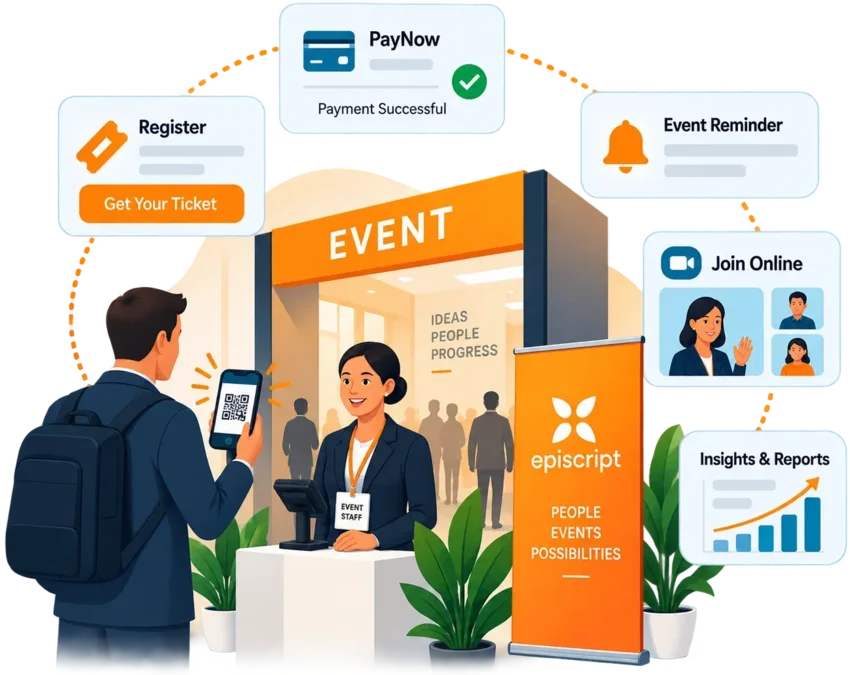
The event management system links your contact lists, invitations, registration forms, ticketing, payments and check-in to one record for each event.
A confirmed registration issues the ticket, takes the payment and adds the attendee to the check-in list without anyone retyping a name.
The system follows your own event formats, ticket types, discount rules, approval steps and reporting requirements. Committee members, marketing staff and front-desk teams work from the same attendee record, whether the event runs in a hotel ballroom, over Zoom, or across both at once.
AI features can also assist with repetitive work such as drafting reminder emails and grouping survey responses, with your team reviewing the output before it is released.
Associations and professional bodies that also manage subscriptions, grades and CPD records often run events alongside our membership management system.
Every event moves through the same six stages, and each stage writes to the same record. Nothing is rekeyed between the invitation and the final report.
Set up the event, the ticket types and the prices, then publish the event page and add the date to the shared calendar.
Segment the contact list and send invitations in batches. Every RSVP lands against the event as it arrives.
Attendees pick a ticket, apply a promotion code and pay by PayNow or card. The confirmation and receipt follow immediately.
Automatic email and SMS reminders reach registrants before the date, carrying directions or the joining link for online sessions.
Scan the QR code at the door, admit online attendees through the same list, and register walk-ins at the counter.
Surveys go out automatically. Attendance, ticket income and feedback appear in the event report the same week.
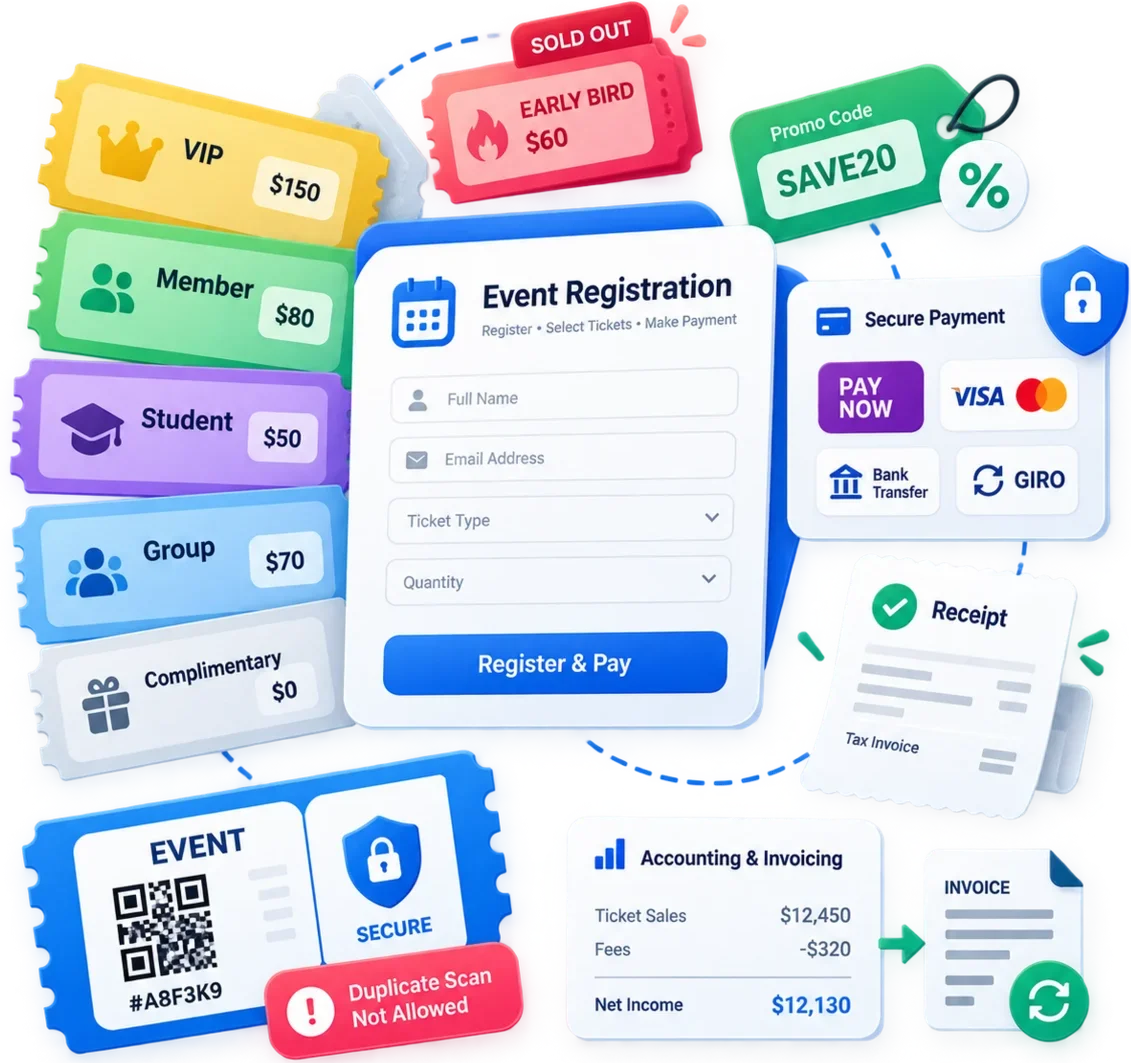
Registration and ticketing run from one form that you control. Build the ticket types the event needs, decide who sees which price, and let the system close each tier when it sells out or reaches its cut-off date.
Ticket income posts against the event rather than sitting in a separate sales sheet, and the same figures reach your accounts through our invoicing software or your existing accounting system.
Filling the room takes more than a registration form. These capabilities cover the work between announcing an event and opening the doors.

Segment contacts by organisation, membership grade, past attendance or stated interest, then invite the list that matches the event. Each contact carries its own history, which stops the same person receiving three copies of one invitation.
Send invitations in batches and track every RSVP against the event. The system chases contacts who have not replied, and the guest list rebuilds itself as acceptances and declines arrive.

Design and send campaigns to a segmented list before, during and after the event. Open and click figures show which message filled the room and which one nobody read.

Push a venue change, a programme update or a joining link the moment it matters. Registrants receive it by email or SMS, and the system logs what was sent to whom.

Build the event page yourself: programme, speakers, venue details, ticket options and the registration form, in your own branding. Publish it under your own domain and edit it while registration is still open.

Hold every upcoming event in one calendar. Members and customers browse what is coming, and your team spots two events landing on the same evening before the invitations go out.
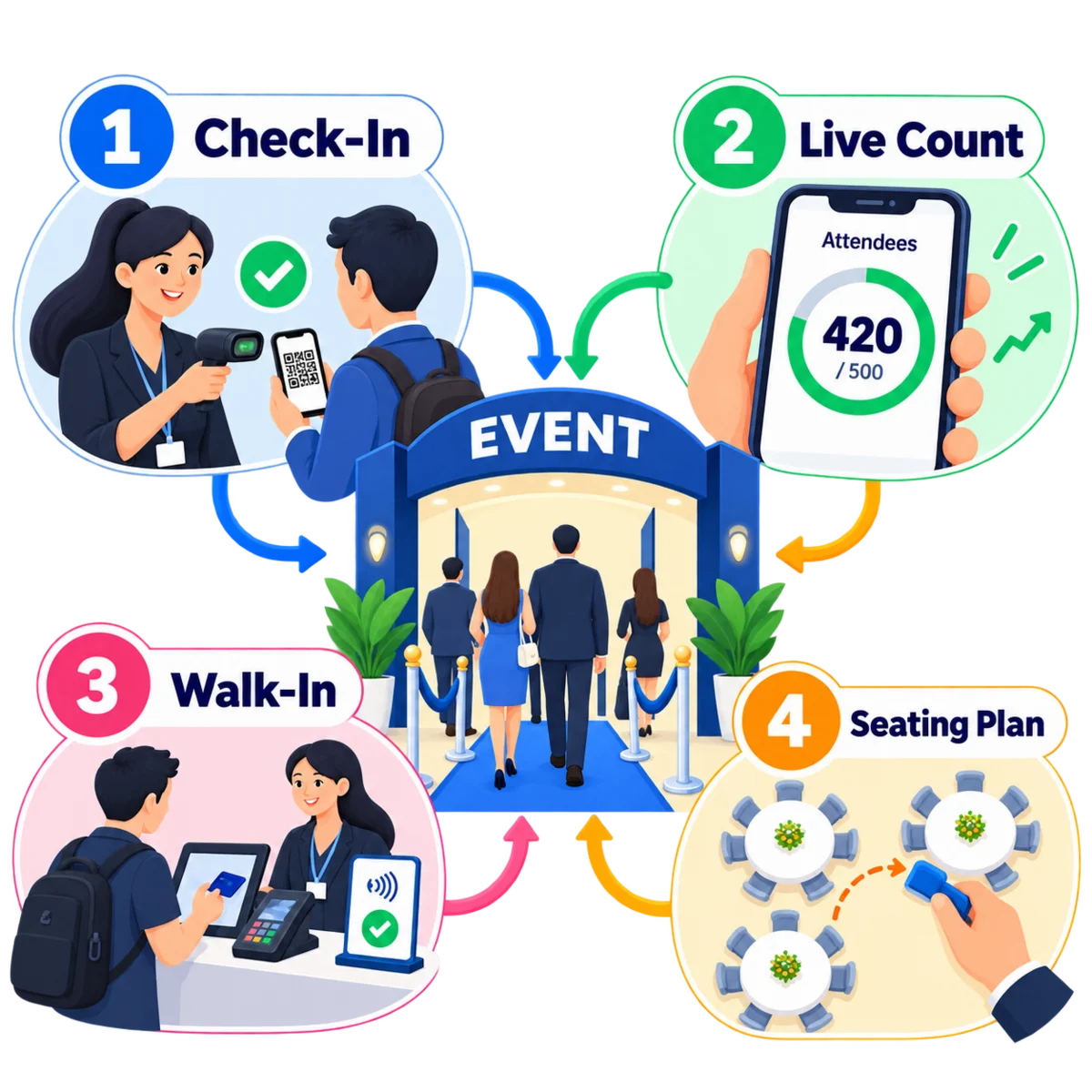
Check-in draws on the attendee list your registration already built. Staff scan the code on a ticket, the attendee is marked present, and the arrival count updates for everyone watching the door.
Organisers watch the count from a phone during the event, and the final attendance total is ready before the room is cleared.
Every registration, payment and scan feeds the same reporting layer, which is where the case for next year's budget usually comes from.
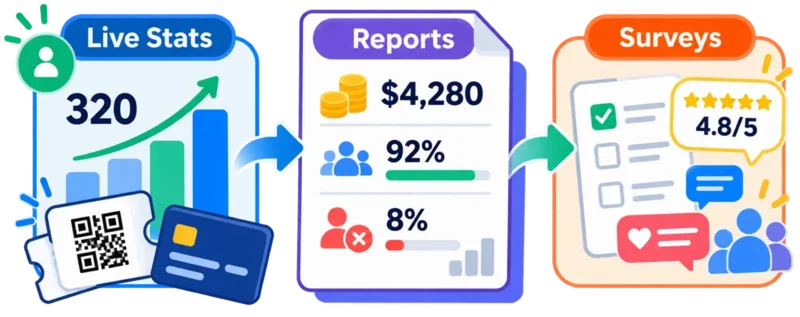

Watch registrations by ticket type, promotion code and source while the event is still selling. Slow-selling ticket tiers show early, giving you time to run another campaign or adjust the price.

Compare ticket income, attendance against capacity, no-show rates and sponsor numbers across events and across years. Export the figures your committee or board asks for.

Surveys reach attendees on a delay you set after the close, and responses attach to the event and the individual. Scores by session tell you which speaker to invite back.
The rules change with the event. A member briefing, a paid conference and a public workshop each need their own registration flow, and the system carries all of them.

AGMs, EGMs, member briefings, CPD sessions and annual dinners, with attendance recorded against the member record and member pricing applied at registration.

Multi-session programmes, delegate and sponsor passes, speaker schedules and hybrid streaming for colleagues and clients joining from overseas offices.

Course intakes, attendance registers and completion records, kept in the form your accrediting body expects for CPD or professional certification.

Exhibitions, festivals, workshops and fundraising nights sold to the public, with tiered pricing, promotion codes and a public event page you control.
AI features in event management software work with information already held in your own event records. Each one is scoped with you, built in its own phase and tested before an event relies on it, and a person reviews the output before an attendee sees it.
AI drafts the invitation, the reminder and the thank-you message from the event brief and your previous campaigns. Your marketing team edits the wording and sends it.
AI reads registration and attendance history for comparable events and estimates how many registrants will turn up, helping you plan catering quantities and venue capacity more accurately.
AI groups free-text survey answers into themes and names what changed since the last event, rather than leaving four hundred comments for one person to read.
AI flags duplicate contacts, stale job titles and addresses that bounced last time, so the invitation list is checked before the campaign leaves.
AI drafts answers to the questions that fill the inbox before every event: programme times, venue directions, invoice requests and ticket transfers, using your own event records.
AI recommends sessions to each delegate from the track they registered for and the sessions they attended previously, helping delegates discover relevant sessions they might otherwise miss.
Your organisation already runs accounting, payment and messaging tools. The event system can integrate with them rather than asking you to replace them, and each connection is scoped and built as part of the project.
If you run something that is not on this list, tell us what it is and we will scope the connection.
A packaged platform starts quickly and covers the common case. A custom build follows your own registration rules, payment methods and records. Both are reasonable choices, and the table below sets out where they differ.
| Point of Comparison | EpiscriptCustom Build | Typical ProductOff-the-Shelf Platform |
|---|---|---|
| Registration and ticket flow | Forms, ticket tiers, member checks and approval steps follow your own process. | Usually based on the platform's existing registration flow and configuration options. |
| Payment collection | PayNow, cards, bank transfer and GIRO can connect through agreed merchant accounts and gateways. | Available methods depend on the provider and plan, and transaction, usage or ticket fees may apply. |
| Branding and event pages | Can be published under your own domain and designed around your branding. | Branding and custom-domain options vary by platform and subscription tier. |
| Attendee data and PDPA controls | Data, permissions, consent records and activity logs can be designed around your organisation's requirements. | Data is stored within the vendor's platform, and hosting, retention, permissions and export options depend on the vendor. |
| Membership, CRM and accounting | Connections are built around the systems you already run, including member records and accounting workflows. | Usually relies on the platform's supported connectors, API and third-party integration tools. |
| AI features | Can be scoped around your own event data and workflows, and released in agreed phases. | AI capabilities and configuration options are those provided by the platform and its supported integrations. |
| Cost model | Quoted as a project with agreed hosting, licensing and support terms. | Usually subscription, usage or per-ticket pricing, depending on the provider. |
| Changes after launch | The same development team can modify workflows as your events and policies change. | Major product changes depend on the vendor's roadmap, though configuration changes may be available immediately. |
| Speed to start | Requires scoping, design and implementation before the first release. | Usually faster to start, because the core product already exists. |
| Best fit | Organisations with distinctive workflows, integrations, data requirements or recurring operational complexity. | Organisations that can work comfortably within a standard product and want the fastest initial setup. |
Swipe to see the full table
Most organisations run their first event on the system within a few months, then add the rest in later phases.
We walk through one recent event with the people who ran it, then agree the registration rules, ticket types and reports the first release must cover.
You review the registration form, the event page and the check-in screen before development starts, when changes are quickest and least costly to make.
We import contact lists, past attendance and event history from spreadsheets or your current platform, then reconcile the counts with your team.
Run one real event end to end, from invitation through to survey. Front-desk staff practise the scanning flow before a large audience depends on it.
Promotion tools, integrations and AI features follow in their own phases, each one scoped against what the pilot taught you.
We quote against an agreed specification rather than a price list, and the five points below move the number most.
One recurring format costs less to build than in-person, online and hybrid running side by side.
Tiered pricing, member checks, approvals and refund handling each add work to the registration engine.
The number of payment methods, and whether tax invoices and accounting entries are issued automatically.
Connections to accounting, membership, CRM, calendar and video platforms are scoped one by one.
Each capability is a phase of its own, and none of them is a prerequisite for going live.
An event management system holds everything one event needs in a single record: the contact and invitation lists, the registration form, ticket types and pricing, payment collection, reminders, check-in and attendance, then reporting and post-event surveys. Rather than one spreadsheet for registrations and another for payments, each stage writes to the same event.
A custom event management system is built around your own registration flow, ticket rules, branding and reporting, and the attendee data sits in a system your organisation controls. A packaged ticketing platform gives you a broad, ready-made product within days, though flows, commercial terms and data arrangements vary by provider and plan. The custom route suits organisations running events regularly against their own member, customer or finance records.
Yes. One event record covers all three formats. Online attendees receive joining links and are marked present through the same attendance list used at the door, which gives a hybrid event a single set of numbers. Ticket types, session times and reminders are set once for the event, whatever format it runs in.
Attendees can pay by PayNow, credit and debit card, and bank transfer, with GIRO available for corporate or recurring arrangements. Payment posts against the registration as soon as it clears, and the system issues the receipt or tax invoice. The exact methods depend on the merchant accounts and gateways your organisation already uses.
The system supports your obligations through consent records, user permissions, activity logs and controlled access to attendee lists. It records what each contact agreed to and when, and it limits who can export a list. Compliance also rests on your own policies and retention practice, so we build the controls your data protection officer asks for.
Cost depends on scope: the number of event formats, the ticket and discount rules, the payment methods, the integrations to accounting or membership systems, and whether AI features are included. We scope the build with you and quote against an agreed specification. A phased release keeps the first invoice smaller by delivering registration, ticketing and check-in first.
A custom build is normally quoted as a project with an agreed support arrangement rather than as a commission on ticket sales. Licensing, hosting and support terms are set out in your agreement rather than fixed on a web page. Tell us how many events and attendees you expect in a year and we will put the commercial terms in writing.
A first release usually covers registration, ticketing and check-in, with promotion tools, reporting and integrations following in later phases. We import contact lists, past attendance and event history from spreadsheets or your current platform, then reconcile the figures with your team before launch. Timelines depend on scope and on how clean the source data is.
The system can integrate with accounting systems such as Xero, with payment gateways, with email and SMS providers, and with calendar and video platforms including Google Calendar, Microsoft 365 / Outlook Calendar, Zoom and Microsoft Teams. Registrations can also write to a CRM or membership database. Each connection is scoped as part of the project, and where a system offers no usable API we agree a scheduled file exchange instead.
AI features work with information already held in your event records. Common examples include drafted invitations and reminders, summarised survey feedback, attendance forecasting from previous events, duplicate detection in contact lists, and session suggestions for delegates. Each feature is scoped with you, built in its own phase and reviewed by your team before an attendee sees the output.
Staff scan the QR code on each ticket from a phone or a handheld scanner, and the attendee is marked present against the registration list. Walk-ins register and pay at the counter, then join the same list. Online attendees are recorded through the joining link, and the arrival count updates live for the organisers.
Yes. Registration can check membership status before it offers a member price, and attendance can be recorded against each member for CPD or accreditation purposes. AGM and EGM registration follows the rules your constitution sets, including proxy submissions where you need them. Conferences, briefings and public events run from the same system, each with its own registration flow.
Events rarely sit on their own. These builds share the same contact records, the same finance figures and the same team.
Hold every contact, enquiry and conversation in one place, then invite the right segment to the next event without exporting a list.
Read more Project Management SoftwareTrack the tasks, owners and deadlines behind each event, from venue booking and speaker confirmations to print deadlines and sponsor deliverables.
Read more School Management SystemFor schools and enrichment centres running open houses, concerts and parent briefings alongside daily class and fee administration.
Read moreShow us one event you ran this year and we will show you how the same event would run on a custom event management system, from the first invitation to the closing report. Episcript builds and supports the software here in Singapore, and the team that builds it is the team that answers the phone.
Prefer to talk it through first? Call 6581 3431.