
Corporate secretarial software
Run every company file, filing and statutory deadline from one system. Episcript builds custom corporate secretarial software around the way your firm already works, from incorporation through to the annual return.
ACRA filings, AGM dates, share certificates, statutory registers and resolutions live in one place. Your team stops retyping the same particulars into four different templates. AI features can be added later to read incoming documents and flag registers that look wrong.
Built in Singapore, for Singapore filings.

Built around your practice
A custom corporate secretarial system brings company records, filings, documents and statutory work into one connected platform.
We map the way your team already works and build the fields, workflows and modules around that process. Company details, officers, share capital, filings and correspondence all sit against the same record.
That gives your team one source of information for company secretarial work, while reducing repeated data entry across forms, registers and client documents.
The statutory cycle
Every client company travels the same route, and each one sits at a different point on it. The system records where each company has reached, and who is holding the next task.
Open the company file, assign the tasks and track each step through to the BizFile submission.
Record officers, shareholders, share capital and the register of registrable controllers.
Log share transfers, allotments, name changes and officer appointments as they happen.
Watch AGM dates by company, issue the notices and store the resolutions against the file.
Follow annual return status on the ACRA filing dashboard, from draft through submission and completion.
Track tax dates beside the secretarial ones, with reminders sent well before each deadline.
Company data
Four modules carry the structure of every client company. Change one detail and every document drawn from it picks up the new value.
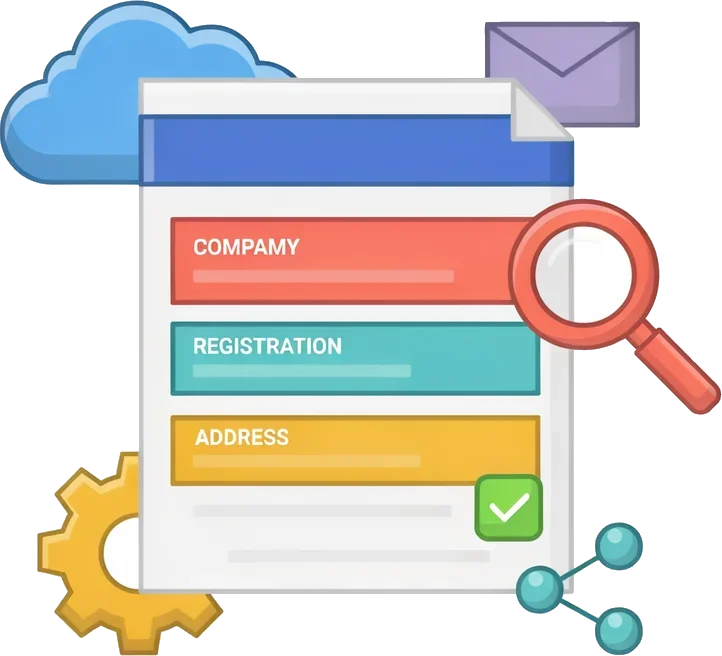
Every client company keeps one record: registration particulars, UEN, GST status, business activities, registered address and contact details. Staff update a field once, and the change reaches the registers, the documents and the reports that draw on it.

Directors, company secretaries, auditors and other officers sit against the company with their appointment and resignation dates. Add a role, remove one, and the system writes the change to the history. That trail supports both your filings and your own reporting.

Track issued and paid-up capital by share class and currency. Amend a class, record a fresh allotment, and the capital position updates across the register of members and the certificates you issue from it. Historical positions remain readable.

Individual and corporate shareholders share one module. Open a company and you see who holds what, which certificates were issued, and how ownership passes up through a corporate holder. Transfers write straight back into the register of members.
Paperwork
The system drafts your standard documents from data already held against the company. Nobody opens last year's file and edits the names. Your team reviews the draft, downloads it as PDF or Word, then sends it to the client from the same screen.

Deadlines and registers
Six modules watch the dates and the registers. Firms that also run wider compliance programmes can extend the same platform with our corporate compliance software.
Every change in a company's history stays on record: share transfers, allotments, name changes and updates to particulars. Open a past change to read what happened, or start a new one from the company file.
Maintain the register of registrable controllers alongside beneficial ownership details, with registers of nominee directors and nominee shareholders built beside it where your firm keeps them. The system flags missing particulars and lapsed entries.
One dashboard reports the status of every filing. Check what has been submitted, what is complete and what still waits on a client signature, without opening each company in turn.
Automatic reminders go out before AGM, ECI and GST dates. You set the wording, the lead time and the follow-up rule, then track delivery. Firms using WhatsApp can send the same reminder through it.
Alerts fire when a company misses something: a late AGM, an overdue filing, an officer record with a missing or overdue update. Your team chases the client early, rather than finding the gap during a year-end review.
Watch expiry dates on tenancy documents, nominee agreements and director identity documents. The system warns you ahead of each date, so a renewal reaches the client before the document lapses.
CSP obligations
Since the Corporate Service Providers Act came into force in June 2025, Singapore CSPs have additional compliance obligations and records to maintain. The registers matter, and so does the record of who touched them.
The system holds each register against the company it belongs to, and updates it from the data your team already maintains. Every edit writes to an audit trail with the user and the timestamp. Permissions follow your own structure. A staff member sees the clients they work on, and the registered qualified individual signing off the work sees the file behind it.
Customer due diligence and AML record keeping sit outside the standard module set. Where your firm runs them, we scope the workflow with you and build it as its own phase. Software supports the record. The obligation stays with your firm.
Client access
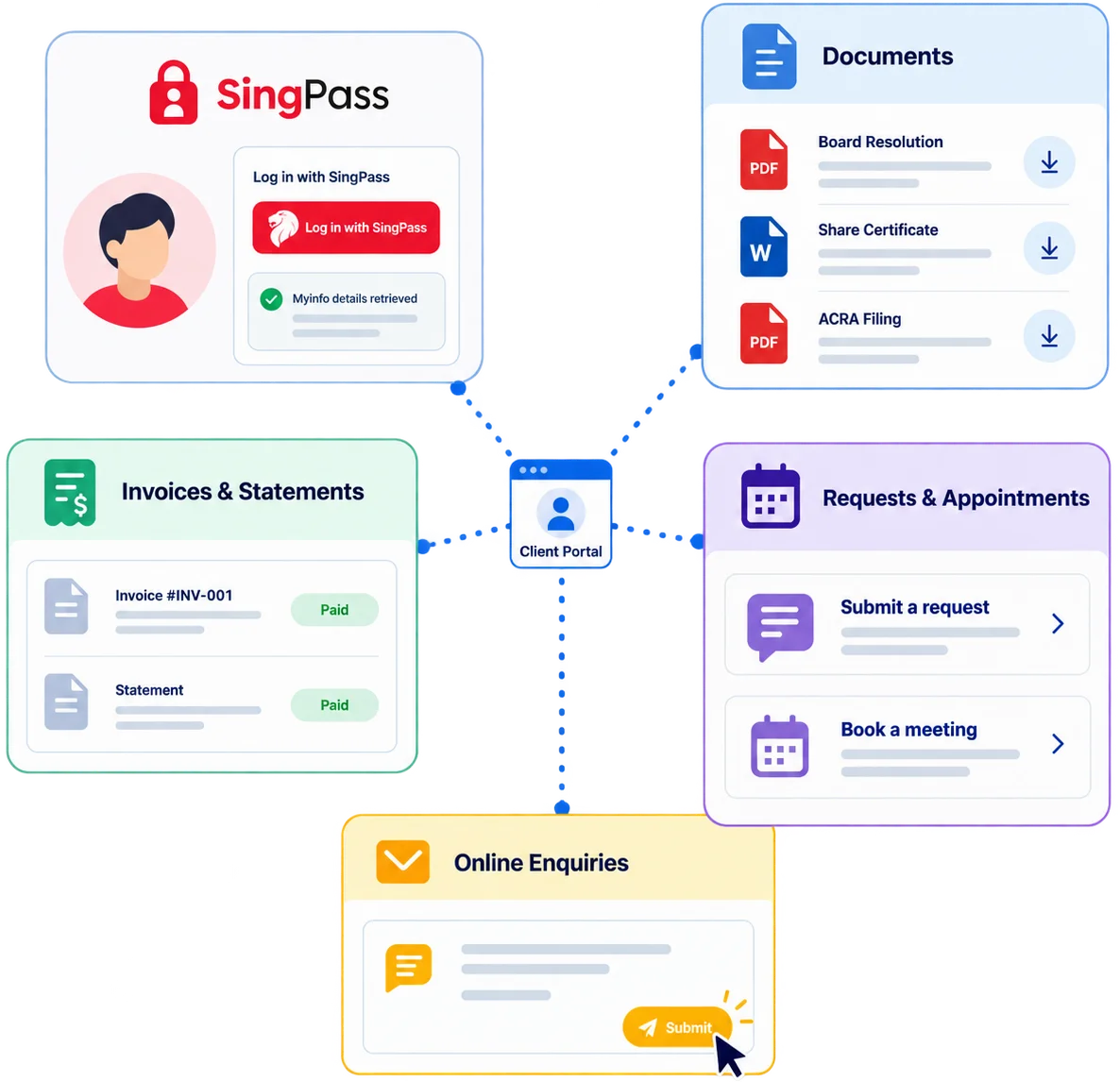
Clients sign in and serve themselves. They download documents, read invoices and statements, submit requests, book a meeting and complete any form you have published. Each action writes to the log against that company, which settles the question of who asked for what.
Integrations
We scope each connection against the platforms your firm already runs. Where another product publishes a suitable API, we can quote that integration as part of the build.
Module library
The modules above carry the daily work. Behind them sits a wider library, grouped as your firm would group it. We switch on what you need, quote the rest as later phases, and build anything your firm runs that is not listed here.
Raise the fee, chase it and reconcile it against the client record. Firms billing beyond secretarial work can widen this into our invoicing software.
The internal side: jobs, packages, client data and the audit trail behind all of it.
Enquiries in, and relationships kept warm once the client signs.
What was said, when it was said, and what left the office.
Answers your team currently digs out of spreadsheets.
Who reaches which client, and what the record shows afterwards.
Capability
AI features for corporate secretarial software are scoped with you and built in their own phase. Each one works with information already held in your system, and you see it running before it goes live.

AI reads an incoming document and pulls out the names, dates, share figures and addresses, then presents them for your staff to confirm before anything updates the register.

AI summarises a company file before a client call: the current officers, the shareholding, recent changes and anything outstanding, drawn from your own records.

AI drafts the reply to a routine client email using the company data behind it. Your staff edit the wording and send it, which keeps the tone yours.

AI scans registers for entries that look wrong: a missing controller, a shareholding that no longer adds up, an officer with no appointment date. Each finding lands as a task.

AI ranks the companies that need attention this week, using deadline dates, filing status and how long a request has waited on a client response.

AI answers client questions inside the portal, using information from their own company file. Anything it cannot answer routes to the staff member handling that client.
Weighing it up
How a custom corporate secretarial system compares with an off the shelf platform.
| Point of comparison | EpiscriptCustom build | Typical productOff the shelf platform |
|---|---|---|
| Fit to your process | Built around your checklists, approval steps and job allocation | Configuration generally follows the options and workflows provided by the platform |
| Document templates | Your own wording, merged from live company data | Templates follow the formats and editing options the platform provides |
| Singapore filings and registers | ACRA filings, AGM dates, RORC and nominee registers tracked as standard | Strong where the vendor serves Singapore, thinner elsewhere |
| Data model and reporting | Fields, relationships and reports designed around the way your firm records and analyses client information | Data structures and reports generally follow the fields and reporting options provided by the product |
| Client portal with SingPass login | Included in the build | Client portals are common, SingPass login less so |
| Accounting integration | Xero, QuickBooks and Zoho Books, mapped to your accounts | Usually available, with fixed field mapping |
| Adding a module later | Quoted and built as its own phase | New functionality depends on the vendor's available modules, integrations or development roadmap |
| AI features | Scoped with you and built to work with your own client data | AI functionality generally follows the capabilities offered by the platform |
| Commercial model | Quoted per project, with licence terms set in your agreement | Recurring subscription, usually priced per user |
Swipe to see the full table
We walk through your filing checklists, document wording and approval steps, then agree what the first phase covers.
You review working screens as they arrive, rather than a specification. Changes come cheapest at this point.
We map your spreadsheets or your current system, run a test import for you to check, then load the live data.
Your staff train on their own client records. Support continues after handover, by phone, email or video call.
Implementation
Most firms run on the first phase within a few weeks. The number of modules and the depth of customisation set the pace, and larger builds with portals and integrations take longer.
Nobody has to move everything at once. Firms usually start with company records, document generation and reminders, then add registers, billing, the portal, reporting and AI features as later phases. Each phase carries its own quote and its own release, which spreads the cost across the financial year.
Incorporation jobs and internal deadlines can also feed a wider view of the firm's workload through our project management system.
Questions
Corporate secretarial software, also called company secretarial software, holds company records and runs the statutory work sitting on top of them. One record per company covers officers, shareholdings and share capital. From there the system drafts documents, tracks filing deadlines, maintains the statutory registers and gives clients somewhere to collect what they need.
At minimum: company records, officers and shareholdings, statutory registers including the RORC, and document generation for resolutions and certificates. Add deadline tracking for AGMs and annual returns, plus an audit trail on every change. Other useful additions include a client portal with SingPass login, annual fee billing and accounting integration.
Yes. The system drafts them from the data already held against the company. Your team reviews the draft, downloads it as PDF or Word, then sends it to the client. Templates carry your firm's own wording rather than a fixed house style, and each finished document files back against the company record.
Yes. Statutory dates are tracked per company, with reminders before each one and alerts when something falls overdue. AGM dates, annual return status, ECI and GST deadlines sit on the same view. A filing dashboard shows what has been submitted, what is complete and what still waits on a client signature.
Yes. The register of registrable controllers comes as standard, with beneficial ownership particulars held against the company. Registers of nominee directors and nominee shareholders are built alongside it where your firm maintains them. Every entry carries its own history, so you can show what changed, who changed it and when.
Yes. A dedicated module records nominee agreements, indemnities, the parties involved and every expiry date, with supporting documents held against the same company file. The system warns you before an arrangement lapses, and the register entries draw on that record rather than on a separate spreadsheet.
These workflows sit outside the standard module set. Where your firm runs them, we scope the process with you and build it as its own phase. That covers the checks you carry out, the documents you collect, the risk rating you assign and the review dates that follow. The obligation stays with your firm, and the system keeps the record.
Yes. The client portal supports SingPass login, so clients sign in without another password to remember, and details pull through from Myinfo. Once inside they download documents, view invoices and statements, submit requests and complete forms you have published. Every portal action writes to the activity log against that company.
Yes. Invoicing data syncs with Xero, QuickBooks and Zoho Books, which keeps invoice status, payments and revenue aligned across both systems. WhatsApp and email campaigns connect the same way. We scope each integration against the platforms your firm actually runs, and quote others where the vendor publishes a suitable API.
The system is hosted in Singapore, with regular automated backups and secure access controls. Inside the application, access is granted by role and by client, documents carry their own permissions, and system activity is recorded through audit logs. Hosting and security arrangements can be scoped to meet your own policies.
Yes. We map your spreadsheets or your current database to the new structure, clean the data with you, then load company records, officers, shareholdings and document history. You check a test import before the live run, and nothing is dropped without your sign-off.
Yes. Most firms begin with company records, document generation and reminders. Registers, billing, the client portal, reporting and AI features follow in later phases. Each phase is quoted and released on its own, which spreads the cost across your financial year and keeps the first release small enough to test properly.
Most firms run on the first phase within a few weeks. Scoping and template work take the opening stretch, then data migration, testing and training follow. The number of modules and the depth of customisation set the pace. Larger builds with portals and integrations run longer, and we agree the schedule before work starts.
Qualifying Singapore companies may be able to seek government support for transformation projects. The Enterprise Development Grant currently supports qualifying project costs including software, subject to the prevailing eligibility criteria and assessment. Grant approval is not guaranteed and should be confirmed before the project is committed.
Related builds
Wider compliance programmes, policies and obligations, tracked beyond the statutory filings.
Read more Custom CRM softwareA fuller pipeline for firms chasing corporate work, with scoring, routing and campaign tracking.
Read more Project management softwareTrack every incorporation, strike-off and annual filing job, with tasks and deadlines assigned across the team.
Read more Invoicing and paymentsBilling that reaches past secretarial fees, with statements, reconciliation and payment collection.
Read moreNext step
Whatever the size of your firm or the complexity of your clients' needs, the Episcript Corporate Secretarial Management System is customised to match your exact workflows and compliance requirements. Book a demo and we will walk through it with a real company file.