
Run sales, inventory, purchasing, invoicing, projects and payroll from one connected ERP system. Episcript builds the software around the way your business works, with every module sharing the same data.
Built for distributors, contractors and retailers who have outgrown their spreadsheets.
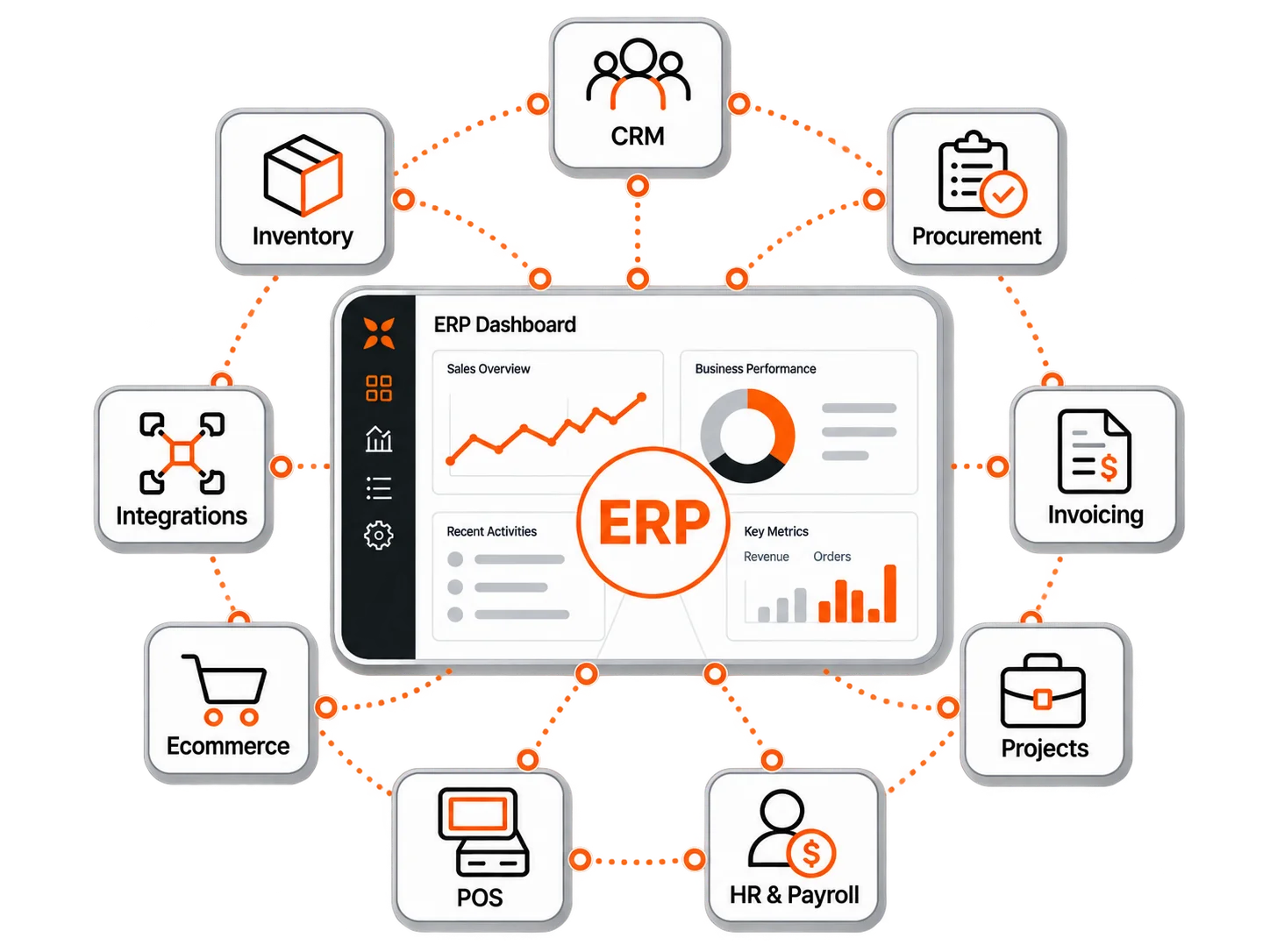
Start with the ERP modules your business needs now, then add more later without creating another data silo.
The CRM tracks every enquiry from first contact to signed order →. Leads route to a named salesperson, and quotations, calls and appointments sit on the contact record.
Stock counts update as goods move in, out and between warehouses. Serial numbers, stock codes and reorder alerts keep the shelf and the screen in agreement.
Issue GST invoices, credit notes and statements from the order they belong to →. Reminders go to late payers on the schedule you set, and payments post against the invoice as they clear.
Purchase requests travel through the approvers you name, then convert to purchase orders. Supplier records, budgets and three way matching sit in the same module.
Every contract, delivery order and certificate files against the record it belongs to. Indexed search finds a document by name, category or the words inside it.
Plan projects on a Gantt chart with dependencies, milestones and named staff. Time logged against a task feeds project costing and the client invoice.
Payroll runs from the same employee record that holds leave, claims and attendance. Payslips, CPF submissions and statutory reports issue on your own schedule.
Take payment at the counter, on a tablet or on the road. Sales write straight to stock, and staff commission calculates as the receipt prints.
Goods received, goods sold and money collected run through the same records. A sales order reserves the stock, the delivery order prints from that same line, the invoice follows the delivery, and the payment closes the loop.
Where stock control is the whole job on its own, the inventory modules can be built first and the rest of the ERP added in later phases.
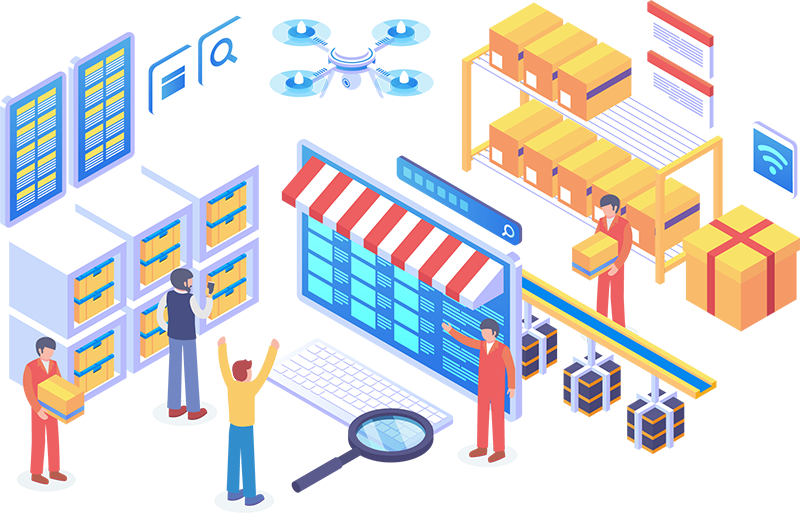
Each module can go further than the core described above. Because the ERP is custom built, the final functions, workflows and reports are defined around your requirements.
 CRM
CRMSales opportunities and tasks sit beside the contact, with reports across the whole sales pipeline. Invoicing, inventory and projects read the same customer record, so nobody keeps a second customer list.
 Inventory management
Access controls decide who can adjust a stock count, and detailed stock reports break holdings down by location and product. Sales and purchase orders reserve and receive stock against the same item records.
 Invoicing and payment management
Sales orders, purchase orders and delivery orders print from the same records as the invoice, each in your own layout. Multi-currency billing covers the customers you invoice overseas.
 Document management
Word, PDF, Excel, image, video and audio files upload by drag and drop. Access is restricted by user role, which keeps contracts and staff files away from anyone who does not need them.
 Project management
Each project carries its own budget, and dashboards show progress, staff utilisation and how the project is performing against that budget.
 Procurement management
Goods received against a purchase order update inventory, and the supplier invoice passes to accounts from the same order. Expense tracking and management reports show spending against each budget.
 HR and payroll
Staff apply for leave and submit claims through self-service, and payslips follow a layout you configure. The module can extend to performance reviews and HR analytics.
 Point of sale
Each outlet runs its counters from the shared catalogue, with product lookup, barcode and QR scanning, returns, and staff permissions set by role.
 Ecommerce
Product variations, promotions and vouchers are set up once in the ERP. Customers choose delivery or collection, overseas buyers can pay in their own currency, and online sales report alongside the rest of your figures.
 Integrations
Accounting, email, calendar, messaging and marketing tools connect to the ERP. The data flow between them, and any automation on top, is scoped around the systems you already use.
The counter reads the same product list as the warehouse. A sale drops the stock count immediately, applies the loyalty points, and prints a receipt in your own layout. Split payments, refunds and credit notes all post back to the customer record.
The online store draws products, prices and stock from the ERP rather than a second catalogue. Orders placed at midnight appear in the same order queue as the ones your sales team keys in. Customers pay by card, bank transfer or PayNow, and the invoice issues from the same module that bills your trade accounts.
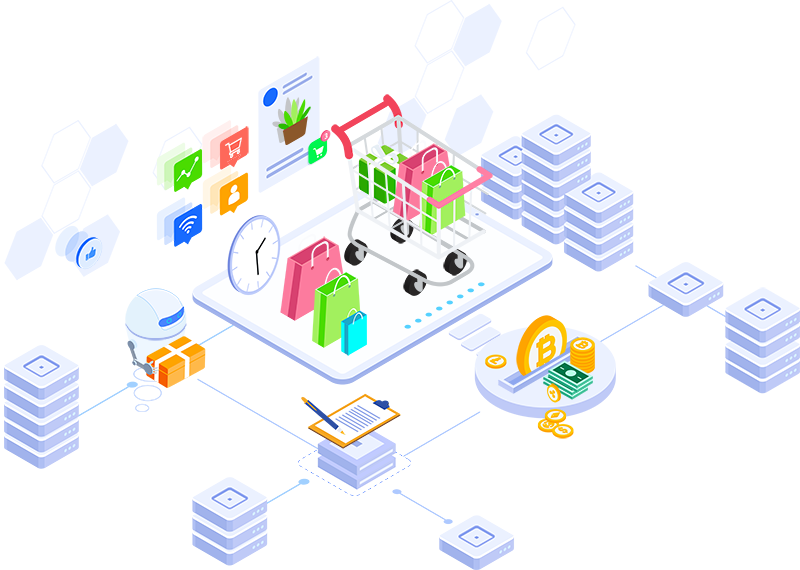
AI features are scoped with you and can be introduced in their own phase. They work with information already held in your ERP, with each workflow tested before it goes live.
AI reads each new enquiry, scores it against the deals you closed before, and assigns it to the salesperson most likely to win it.
AI drafts the reply, the quotation cover note or the payment reminder from the customer history in your ERP. Your staff edit the wording and send it.
AI reads sales history and supplier lead times, suggests reorder points, and names the products likely to run short next month.
AI reads a supplier invoice or delivery order, pulls out the line items, and matches them against the purchase order before an approver signs.
With a packaged product such as SAP, Oracle NetSuite, Microsoft Dynamics 365 or Odoo, you subscribe or buy a licence, pick an edition, then configure the platform and adjust your processes where they do not fit it.
A custom ERP is the other route. Rather than configuring a vendor's product, we write the modules around the way your business already runs, with every module reading the same database. Neither approach suits every business, and the comparison below sets out where each one wins.
A custom ERP usually starts to make sense when spreadsheets and separate apps stop keeping up. Think of a distributor holding stock in two warehouses, a contractor costing each project against its progress claims, or a retailer selling at the counter and online from one catalogue. None of them is a large corporation, and each can start with the modules it needs most.
In a custom build the CRM is one module of the ERP rather than a separate product. It handles the customer up to the signed order, then stock, invoicing and payroll carry on from the same record, which your sales team and your accounts team both open.
Both approaches can work well. The better fit depends on how standard your processes are, how much control you need, and how quickly you want to go live.
| Point of comparison | EpiscriptCustom ERP build | Typical productOff the shelf ERP |
|---|---|---|
| Fit to your process | Built around your own workflows, terminology and approval rules | Best fit when your processes can follow the product configuration available |
| Customisation | Features, fields, reports and workflows can be developed specifically for your business | Usually configured through standard options, add-ons and vendor-supported extensions |
| Modules and scope | You define the modules and functions included in each project phase | Commonly sold through editions, bundles or subscription tiers that vary by vendor |
| Implementation speed | Longer initial build where extensive custom development is required | Can be quicker where standard workflows already meet your requirements |
| Pricing model | Project pricing is agreed against a written scope, with hosting and support set out separately | Often subscription or licence based, commonly affected by users, editions and add-ons |
| Integrations | Integrations can be developed around the systems and data flows you already use | Strongest where the required connector already exists in the vendor ecosystem |
| Changes after launch | New workflows and features can be scoped and developed as your business changes | Changes depend on available configuration, extensions and the vendor product roadmap |
| Local requirements | Singapore requirements such as GST, PayNow, CPF workflows and local integrations can be scoped into the build | Coverage varies by product, edition and localisation available for Singapore |
| Support | Direct support from our Singapore team for the system we built | Support structure varies between the software vendor, implementation partner and support plan |
Swipe to see the full table
We normally release the ERP in phases, starting with the module that costs your team the most time. Each phase is tested with real workflows and data before the next one begins.
Your team can keep working throughout the implementation. Existing systems can remain in place during transition, while staff learn and test the new ERP one phase at a time.
We sit with the people who run the process and map it, step by step, including the exceptions nobody writes down.
You receive the module list, the integration list and a price against it. The scope decides the price, not the other way round.
The first phase focuses on the processes creating the most manual work or operational friction. You test each screen and tell us what to adjust before we move on.
Customers, stock, open orders and outstanding balances move across. Your team checks a test import before we run the real one.
We train each role separately, then hand over. Support after launch follows the arrangement written into your agreement.
Singapore's invoicing, payment, payroll and data-control requirements are scoped into the same system as everything else, rather than added afterwards.
GST invoicing is built into the invoicing module. Where InvoiceNow connectivity is required, it can be scoped as an integration based on the applicable IRAS requirements and the InvoiceNow-ready provider used for the project.
Invoices and customer payments can support PayNow alongside cards and bank transfers, with payment records linked back to the customer and invoice.
CPF submissions and statutory payroll reports are prepared from the payroll run itself, rather than keyed into a separate form at month end.
Role-based permissions, access controls and activity logs can support your organisation's PDPA processes by controlling who can view or change business and customer records.
The ERP connects to the tools your team opens every day. Invoices post across to your accounting platform, calendar entries sync both ways, and messages go out over WhatsApp from inside the customer record.
A telephony service lets your team make calls and send text messages without leaving the customer record. Tell us what you already run, and we will confirm exactly what each integration covers before you commit to anything.
ERP software brings core business processes into one connected system and database. Instead of running sales, inventory, purchasing, invoicing, projects and payroll in separate applications, an ERP lets those functions share the same records, workflows and reporting.
The price follows the modules you need, the number of people using them, and what the ERP has to connect to. A build covering sales, stock and invoicing costs far less than one adding payroll, projects and a customer portal. We scope the work with you first, then quote a fixed price against that written scope.
Yes. Our ERP, automation and digital transformation projects are eligible for government grants in Singapore. Tell us during scoping that funding matters, and the quotation and supporting documents will be prepared around what the scheme asks for.
The timeline follows the number of modules in the first phase. A single module reaches your team quickly. A full ERP covering sales, stock, purchasing, invoicing and payroll takes considerably longer, and we split it into phases rather than one launch. You receive a written schedule with the quotation, and every phase carries its own dates.
Yes. The ERP connects to Xero, QuickBooks, Microsoft 365, Google Workspace, Mailchimp, Facebook and WhatsApp. Invoices post across to your accounting platform, calendar entries sync both ways, and staff send WhatsApp messages from inside the customer record. A telephony service can be added as well, for calls and text messages.
Yes. Most clients begin with the modules that hurt most, often stock and invoicing, then add procurement, projects or payroll later. Every module writes to the same database, which means a later addition reads the history already there. We agree the order at scoping and price each phase separately.
Yes. The invoicing module issues GST compliant invoices, credit notes and account statements, and records payments made by PayNow, card or bank transfer. Reminders chase overdue invoices on a schedule you set. Multi currency invoicing is available where you sell overseas, and every document carries your own layout and numbering.
InvoiceNow connectivity can be scoped into the invoicing workflow where it is required. The exact implementation depends on the applicable IRAS requirements and the InvoiceNow-ready solution or access-point provider used for the project, so we confirm the integration approach during scoping.
We migrate it. Customer records, stock lists, open orders and outstanding invoices move across from spreadsheets, accounting software or an older system. We clean and map the data with your team, run a test import, and ask you to check the result before launch. Records that no longer earn their place stay in an archive.
Through permissions, activity logs, consent records and access controls. Each role sees only the records it needs, and the system logs who opened or changed a record. Software alone does not make an organisation compliant. Your own policies, retention rules and staff training carry the rest, and the ERP records the evidence behind them.
Enquiry scoring, drafted replies, stock forecasting, supplier invoice reading and anomaly alerts are the common requests. Each one works with information already held in your ERP rather than a model trained on your files. We scope the features you want, price them as their own phase, and demonstrate them before they go live.
When your process is the reason customers stay, or when no product on the market fits it without heavy configuration. Packaged ERP platforms carry a great deal of ready made functionality and reach your team quickly. A custom build costs more at the start and fits exactly, which matters most where the workflow is unusual.
Ownership, hosting and support are set out in the agreement signed before the build starts, which removes any ambiguity later. We put the arrangement in writing at quotation stage. Ask us about source code, hosting location and response times during scoping, and the answers go into the contract rather than onto a sales page.
GST invoices, reminders, statements and payment records, running as a standalone system or inside the ERP.
Read more Procurement systemPurchase requests, approval routing, supplier records and budgets, from request through to order fulfilment.
Read more Customer relationship managementLeads, contacts, sales pipeline and follow-ups, with every customer linked to their orders and invoices in the ERP.
Read moreBusinesses that come to us for an ERP usually know exactly where the gaps are: the order retyped into the accounts, the stock count nobody trusts, the month-end report rebuilt by hand from three spreadsheets. Bring us the process that costs your team the most hours, and we will map it with you, name the modules it needs and quote against a written scope. We build and support the system here in Singapore, and the people who write your code are the people who answer your call.